How Wi-Fi Monitoring for Warehouses and Distribution Centers Affects On-Time Delivery
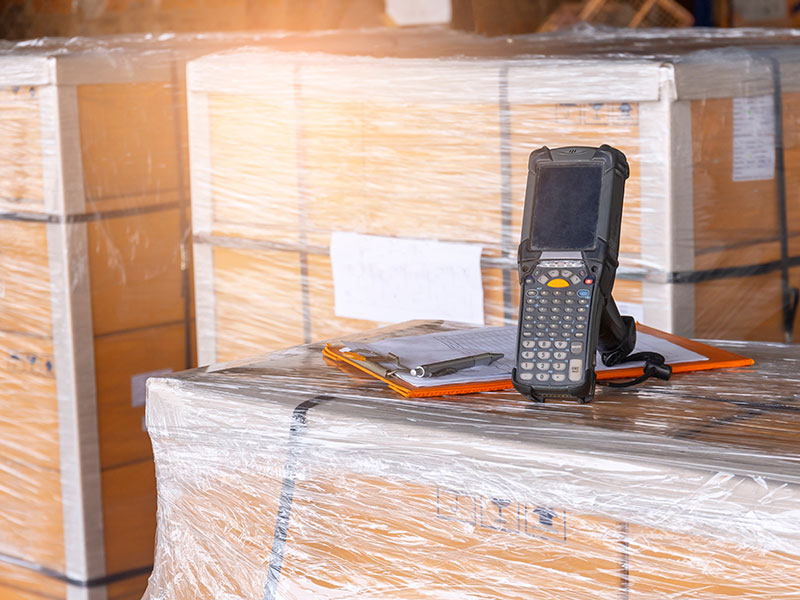
Your infrastructure tools show green. Your pickers still miss scans. Fix that with 7SIGNAL.
For warehouses and distribution centers, Wi-Fi uptime is your linchpin for on-time delivery. Orders are pouring in. That's good. But when you can't scan, voice pick, rely on your AGVs, or link data with your forklifts, delivery stops in its tracks. 7SIGNAL gives operations and IT teams around-the-clock eyes on every connected device to ensure uptime — and deliveries — are on time, so your fulfillment floor runs at the speed your business demands.
Most warehouse IT teams still monitor the network the wrong way, focusing on access points and controllers rather than the devices that actually move goods. So if a picker's scanner drops off the network, an AGV stops mid-route, or a voice headset misses an instruction, the infrastructure dashboard still shows green. By the time your IT team learns a device has dropped, the impact has hit the floor.
See the power of 7SIGNAL live in your environment
Stop guessing, resolve issues in minutes, and know for certain if the issue is the WIFI.
Talk to 7SIGNAL~1,000 metrics & KPIs feeding EYERIS AI.
The fulfillment backbone
Wi-Fi Performance Is Now a Fulfillment Metric
Distribution centers are among the most demanding wireless environments in any industry, and every device on the floor — scanner, headset, forklift, robot — is constantly roaming across hundreds of thousands of square feet. Here is what is at stake for each device type.
Barcode Scanners
Barcode scanners and handhelds are the highest-volume wireless clients in most distribution centers — and the most misdiagnosed. The standard fix for "my scanner is slow" is to blame the device: replace it, update firmware, reconfigure, repeat. Client-side data instead pinpoints the real cause — device, driver, access point, coverage gap, interference — before a single replacement order goes out.
Voice-Picking Systems
Voice-picking systems are acutely sensitive to Wi-Fi latency and jitter. A dropped connection, even for a fraction of a second, can miss a pick instruction — triggering a mispick, recount, or mis-shipment. These are among the most expensive failure modes in warehouse operations, invisible to infrastructure-level tools until a complaint or audit.

Forklifts, AGVs & AMRs
Autonomous forklifts, AGVs, and AMRs are the highest-stakes wireless clients on the floor, depending on continuous, low-latency Wi-Fi for routing, WMS communication, and vehicle coordination. A roaming failure — losing connection during an access point handoff — can stop a vehicle mid-route, cascading into hours of throughput impact and schedule delays.
A uniquely demanding fulfillment environment
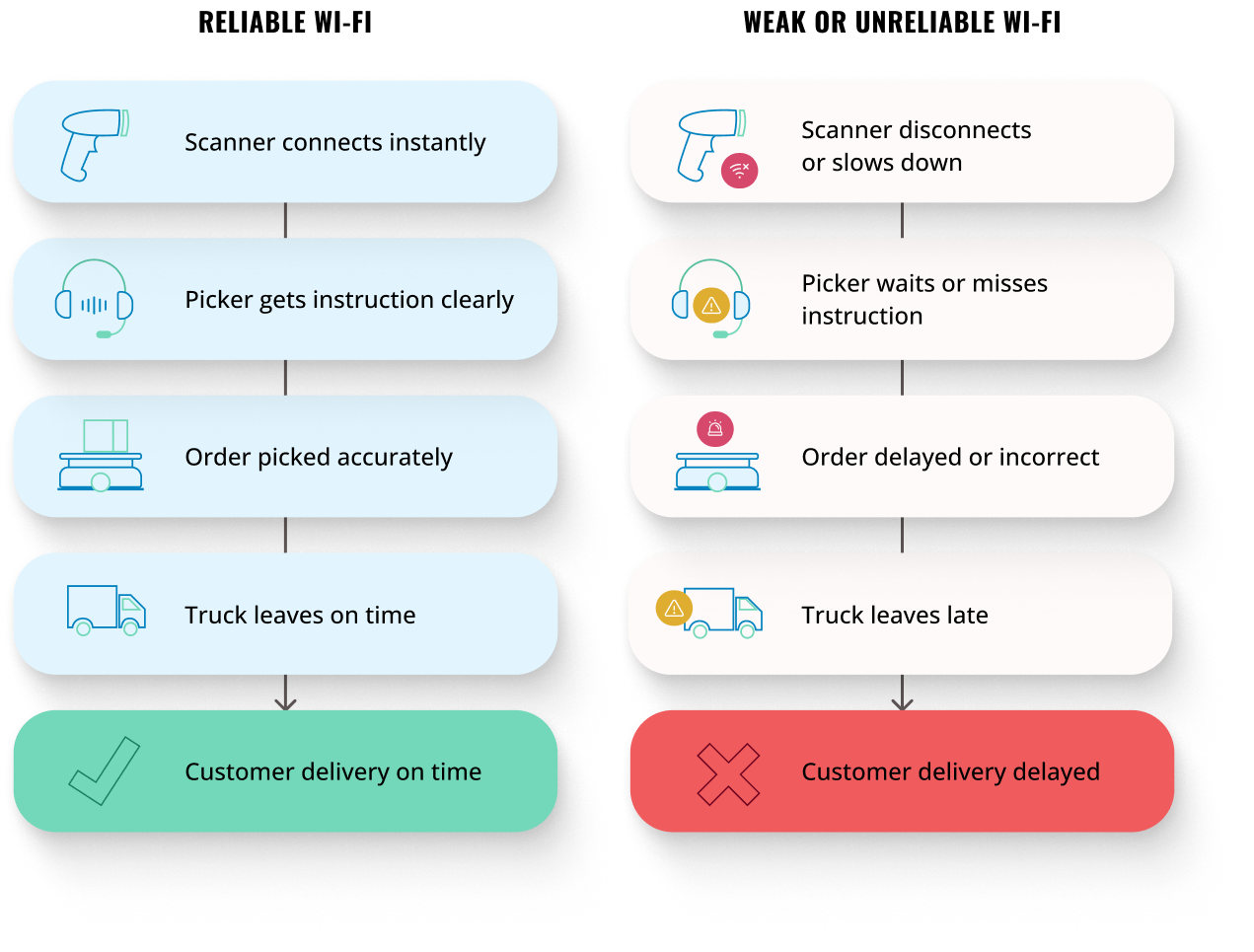
Why Warehouse Wi-Fi Monitoring Is a Fulfillment Operations Problem
Every device on the floor — scanner, headset, forklift, robot — is constantly roaming across hundreds of thousands of square feet, handed off between access points as inventory shifts and racking blocks line-of-sight. A roaming failure that lasts a fraction of a second is invisible to a dashboard watching only the access points, but it is exactly the moment a picker misses a scan or an AGV loses its route.
Powered industrial trucks and connected forklifts increasingly run WMS applications, safety systems, and telematics over Wi-Fi. When a forklift loses its WMS connection mid-task, the operator either works from memory, increasing the risk of accuracy issues, or stops to reconnect, resulting in productivity loss. Multiply that across a fleet of 50 or 100 vehicles, and the network issue looks operational from the outside, with delivery timing at risk.
7SIGNAL provides independent evidence. It helps determine whether the source of a problem is a device, driver, access point, DHCP service, RF condition, or configuration, before teams replace hardware or interrupt fulfillment.
The hidden cost
Brief Network Failures Become Fulfillment Events
When fulfillment stops, losses measured in thousands of dollars per minute pile up fast. Gartner estimates enterprise network downtime at $300,000 per hour, while IDC places critical application failure as high as $500,000 per hour.
In a distribution center, those figures translate directly into unfulfilled orders, SLA penalties, and overtime labor to recover lost productivity.
per hour — enterprise network downtime
per hour — critical application failure
per minute — data center downtime
The 7SIGNAL platform
7SIGNAL Agents: device-level visibility across the entire floor
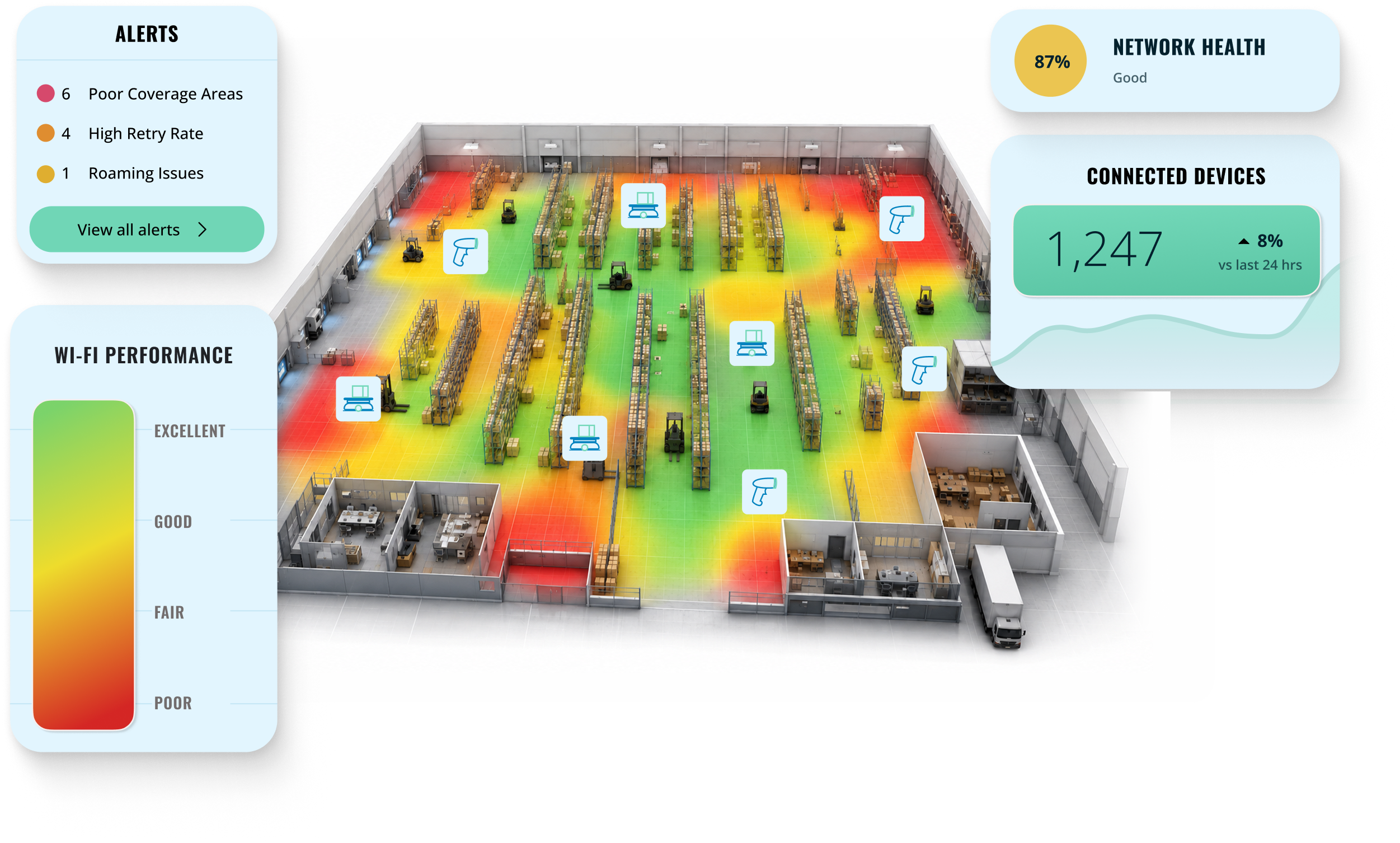
The 7SIGNAL Agent runs on Android, Windows, Linux, macOS, and other platforms — directly on your scanners, voice-picking devices, forklift terminals, and AGV controllers. This gives IT teams real-time visibility into how each device connects, roams, and performs across the facility. You can see which scanner is failing to roam on a specific picker route, which voice headset is hitting latency spikes during peak hours, and which AGV controller is struggling with access point handoffs — before those issues slow fulfillment and delivery.
7SIGNAL Sensors: RF intelligence in every zone of the facility
7SIGNAL Sensors are deployed in the zones where Wi-Fi is most stressed — receiving docks, cross-docking areas, high-bay racking aisles, and packing stations — to continuously and independently measure WLAN performance. They detect co-channel interference, signal shadow zones caused by shifting inventory, and capacity bottlenecks during shift peaks. In a distribution center where the RF environment changes every time a load is received, 7SIGNAL Sensors provide the ground-truth signal data that no infrastructure dashboard can — helping avoid delays that affect delivery.
EYERIS AI: from reactive firefighting to proactive fulfillment
EYERIS AI synthesizes data from 7SIGNAL Agents and 7SIGNAL Sensors to surface root-cause diagnoses that no human review process could reliably catch at the speed of a fulfillment operation. It distinguishes among device-level problems, access point issues, driver mismatches, interference patterns, and infrastructure configuration errors. For a DC IT team managing thousands of devices across multiple shifts, EYERIS AI is the difference between reacting to problems all day and getting ahead of them.
Why traditional tools fall short
Infrastructure Health Is Not Device Experience
An access point can be online while a scanner waits on DHCP, a voice pick times out, or an AGV controller suffers a failed handoff.
Traditional Infrastructure Monitoring
Access Point → Controller → Dashboard
Confirms that infrastructure is up. Often misses brief roaming failures, client driver problems, DHCP delays, and device-level latency.
7SIGNAL Outside-In Visibility
Scanner, Voice Device, or AGV → EYERIS AI → Root Cause
Measures the real end-to-end experience and identifies whether the issue is the device, driver, AP, DHCP, RF environment, or configuration.
From symptom to resolution
AI-Driven Diagnostics Compress Hours into Minutes
Every minute of unexplained Wi-Fi degradation costs money. 7SIGNAL helps warehouse and distribution teams move from reactive firefighting to proactive operations.
Detect
Find roaming, latency, packet loss, and DHCP anomalies across scanners, voice devices, and AGVs.
Correlate
Connect device, RF, infrastructure, and location data.
Diagnose
Identify the real source instead of replacing hardware blindly.
Recommend
Provide prescriptive remediation guidance.
Protect On-Time Delivery
Resolve issues before pickers and AGVs feel them.
Real-world results
Real-world results: global beer distributor, three distribution centers
A global beer distributor selling a mix of domestic, imported, and microbrewery brands across three large distribution centers came to 7SIGNAL with a problem its IT team could not solve. Thousands of Android barcode scanners across all three facilities were experiencing intermittent connectivity failures. Pickers reported that "the Wi-Fi wasn't working," the help desk was flooded, and no one could identify a root cause — because every infrastructure dashboard showed the network as healthy, even as the issues threatened on-time delivery.
The core problem was visibility — or the lack of it. The company could see access points, but it could not see how those Android scanners were interacting with the wireless network.
7SIGNAL Agents were deployed across the Android scanner fleet, giving network managers precise, real-time visibility into how each device connected, roamed, and experienced the WLAN. What had been a flood of vague complaints became a specific, diagnosable set of issues: coverage gaps in high-bay racking zones, access point handoff failures along high-traffic picker routes, and interference patterns caused by device density during peak shift hours. That made the root cause clear and the next steps actionable.
With that visibility in place, the IT team moved from reactive firefighting to proactive management. Problems were identified and fixed before pickers reported them, the scanners stayed connected, and help desk call volume dropped — because the issues were being solved at the network level rather than the device level, helping keep orders moving on time.
"Without working scanners, efficient business operations are impossible."
— Global Beer Distributor case study, 7SIGNAL
Measured business outcomes
Protect Throughput, Pick Accuracy, and On-Time Delivery
Warehouse and distribution-center customers use 7SIGNAL to reduce downtime, shorten investigation, recover productivity, and eliminate recurring wireless failures.
Fewer help desk calls
Reduction in help desk call volume, driven by proactive issue detection.
Faster picking
Improvement in picking productivity.
Faster resolution
Reduction in time to ticket resolution.
A practical optimization framework
Top 10 Warehouse Wi-Fi Monitoring Priorities for Distribution and Fulfillment IT Teams
Whether you operate a single regional DC or a national network of fulfillment centers, these are the areas where Wi-Fi performance has the greatest impact on throughput, accuracy, and on-time delivery.
- Monitor scanner roaming by route, not by zone average. A 500-millisecond roaming failure is invisible on your infrastructure dashboard and still causes a picker to miss a scan.
- Validate voice-picking Wi-Fi quality separately from data traffic. High throughput doesn't guarantee the low-latency, low-jitter connection voice picking needs. Correlate latency and jitter events with mispick rates to find the real link to fulfillment accuracy.
- Track AGV and AMR handoff performance along every route. An 800-millisecond roaming failure is invisible to infrastructure tools and catastrophic to autonomous navigation.
- Baseline RF performance by zone — and re-baseline when inventory changes. A high-bay zone full of palletized goods behaves differently than an empty aisle. Re-baseline after major inventory moves or facility reconfigurations.
- Monitor forklift and PIV connectivity during shift peaks, when device density and access point competition are highest — not just during the quieter periods when the network looks healthy.
- Detect co-channel interference before it cascades. In dense AP environments, interference that starts as a slowdown in one aisle can become a facility-wide throughput problem by shift's end.
- Standardize Android driver versions across your scanner fleet. Inconsistent versions are a common, underdiagnosed cause of roaming failures. Use device-level monitoring to identify problematic versions and enforce fleet-wide standardization.
- Separate operational Wi-Fi from corporate and guest traffic. WMS systems, scanners, AGVs, and voice-picking devices shouldn't compete for bandwidth with laptops or guest Wi-Fi. Segment by device class and prioritize operational traffic during production hours.
- Alert on leading indicators, not just outages. Configure alerts for roaming failure rates, signal degradation, and DHCP spikes so your team responds before a picker calls the help desk.
- Measure mean time to resolution and drive it down. AI-driven root-cause diagnostics compress triage from hours to minutes, freeing your team to firefight less and focus more on sustained performance.
Warehouse & Distribution Wi-Fi Monitoring FAQ
Warehouse Wi-Fi monitoring continuously measures wireless performance across distribution centers and fulfillment facilities — from receiving docks to high-bay racking to shipping lanes. It helps IT and operations teams understand what scanners, voice-picking systems, forklifts, AGVs, and AMRs actually experience on the network, not just whether the access points are online.
Scanning, voice picking, AGV routing, and WMS communication all depend on continuous wireless connectivity. Even a brief drop — well under a second — can miss a scan, mis-hear a pick instruction, or stop an AGV mid-route, and infrastructure dashboards routinely show green while it happens.
7SIGNAL Agents run directly on scanners, voice-picking devices, forklift terminals, and AGV controllers, measuring roaming, latency, signal quality, and DHCP performance from the device's own perspective as it moves through the facility.
7SIGNAL Sensors are deployed in the zones where Wi-Fi is most stressed — receiving docks, cross-docking areas, high-bay racking aisles, and packing stations — to independently measure WLAN performance and detect co-channel interference, signal shadow zones, and capacity bottlenecks during shift peaks.
EYERIS AI synthesizes data from 7SIGNAL Agents and Sensors to distinguish among device-level problems, access point issues, driver mismatches, interference patterns, and configuration errors — then prescribes the specific remediation step, instead of leaving a DC IT team to triage thousands of devices by hand.
No. 7SIGNAL complements infrastructure monitoring by adding independent, device-level visibility. Controllers and dashboards report infrastructure health; 7SIGNAL shows what the scanners, voice devices, and AGVs on your floor actually experience.
Distribution runs on uptime
These outcomes span IT, operations, and fulfillment management — which is why the business case for warehouse Wi-Fi monitoring is never just about IT cost reduction. It is about protecting throughput, preserving pick accuracy, hitting shipment SLAs, and keeping the wireless network from becoming the constraint in an otherwise optimized distribution operation.
Warehouse and Distribution-Center Wi-Fi Is Too Critical to Leave Unmonitored
With close to 1,000 metrics and KPIs feeding EYERIS AI, 7SIGNAL gives warehouse IT and operations teams the visibility to find problems before pickers feel them, the intelligence to diagnose root causes in minutes rather than hours, and the prescriptive guidance to fix them without guesswork. From the receiving dock to the pick face to the shipping lane, every device on your fulfillment floor gets the same level of monitoring — and it happens without adding headcount.
See how 7SIGNAL keeps Wi-Fi at warehouses and distribution centers reliable to maximize fulfillment throughput and accuracy.
